
Lifty Fifty Training Library / Movement reference
Barbell Flat Bench Press
A horizontal barbell press on a flat bench. Follow the descent, chest contact and press, with the upper back and feet helping establish a stable position.
- Movement pattern
- Push
- Movement type
- Compound · Bilateral
- Equipment & setup
- Barbell · Flat Bench · Rack
Movement demonstration
Silent videoThe video could not load. Open the video directly or continue with the written reference below.
Movement anatomy
Rendered 3D views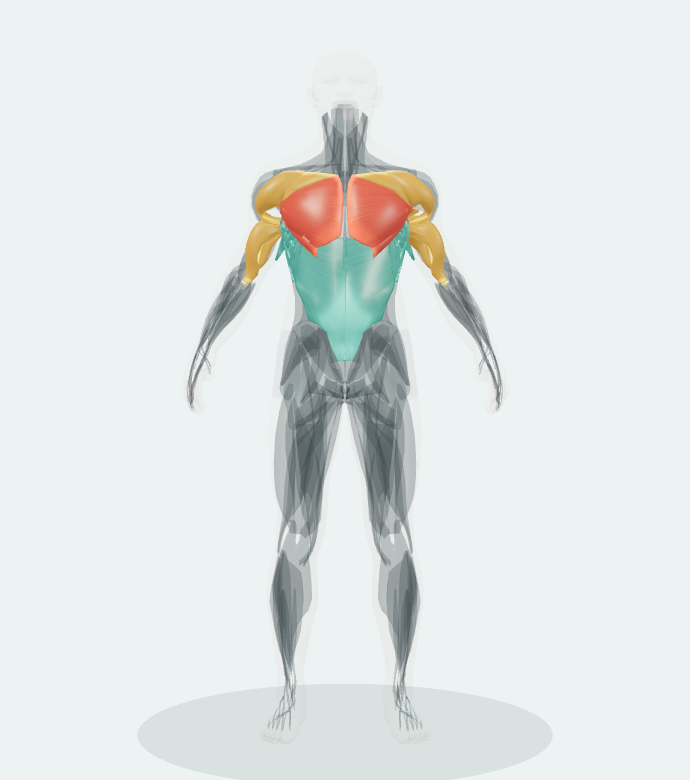
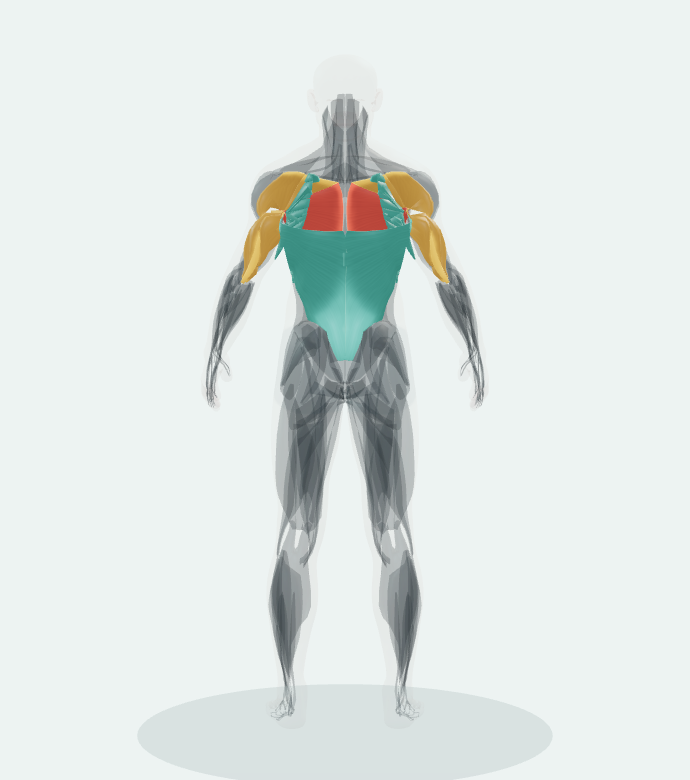
- Primary
- Chest
- Secondary
- Triceps Complex · Deltoids
- Stabilising
- Abdominals · Lats
Selected muscles; full roles below. Not measured activation. Read muscle references
Movement profile
Classification and movement demands.
- Category
- Strength Powerlifting
- Movement pattern
- Push
- Movement family
- Bench Press
- Movement type
- Compound
- Laterality
- Bilateral
- Plane of movement
- Transverse
- Body position
- Supine
- Grip
- Pronated
- Technical demand
- Intermediate
Setup
Setup requirements.
Lie supine on a flat bench with eyes directly under the bar. Plant feet flat on the floor with a slight arch in the lower back — upper back and glutes stay in contact with the bench. Grip the bar slightly wider than shoulder-width using a full overhand grip with thumbs wrapped around the bar. Retract and depress the shoulder blades to create a stable pressing platform. Unrack the bar with straight arms and position it directly over the shoulder joint.
Check the bench, rack and safety supports before unracking. Arrange appropriate spotting and keep a secure, closed grip on the bar.
Equipment and optional accessories
Equipment & setup
Barbell · Flat Bench · Rack
Equipment group
Free Weight
Optional accessories
Barbell Clips · Lifting Belt · Wrist Wraps
Execution
Execution phases.
Descent
Lower the bar under control (2-3 seconds) to the lower chest, roughly at nipple line level. Keep the elbows at approximately 45-75 degrees from the torso — not flared out to 90 degrees. Maintain retracted shoulder blades throughout. The forearms should be vertical when viewed from the front at the bottom position.
Bottom position
Brief contact with the chest — the bar touches but does not bounce. Maintain full-body tightness, shoulder blade retraction, and leg drive readiness. Do not relax or let the shoulders protract.
Press
Drive the bar upward and slightly back toward the rack by extending the elbows and horizontally adducting the shoulders. The bar path follows a slight arc from lower chest to above the shoulder joint at lockout. Push through the full foot to maintain leg drive and arch stability. Lock out elbows fully at the top without losing shoulder blade retraction.
Breathing and bracing
Inhale and brace before lowering the bar. Maintain the brace through the descent and bottom position, then exhale as the bar passes the sticking point during the press.
These notes describe this reference example. Follow the movement variation, range, tempo and effort instructions in your own programme.
Coaching
Coaching cues and common errors.
Coaching cues
- Squeeze your shoulder blades together and down
- Lower to the chest, elbows at about 45 degrees
- Drive the bar up and slightly back
- Push your feet into the floor throughout the press
- Lock out fully without losing your upper-back tightness
Common mistakes to look for
- Flaring elbows to 90 degrees, placing excessive stress on the shoulder joint
- Bouncing the bar off the chest to generate momentum
- Losing shoulder blade retraction during the press (shoulders rolling forward)
- Lifting the hips off the bench to shorten the range of motion
- Uneven bar path or pressing the bar too far toward the face
Muscle roles
Muscle roles in the movement.
Reference roles describe how muscles contribute to the movement. They do not measure your personal activation or growth.
- Primary muscle groups
- Chest
- Secondary muscle groups
- Triceps Complex · Deltoids
- Stabilising muscle groups
- Abdominals · Lats
Scroll across to view all columns
| Muscle | Role | Region |
|---|---|---|
| Pectoralis Major | Primary | Sternal |
| Pectoralis Major | Secondary | Clavicular |
| Deltoid | Secondary | Anterior |
| Triceps Brachii | Secondary | Lateral Head |
| Triceps Brachii | Secondary | Medial Head |
| Triceps Brachii | Secondary | Long Head |
| Serratus Anterior | Stabiliser | — |
| Latissimus Dorsi | Stabiliser | — |
| Transversus Abdominis | Stabiliser | — |
A muscle can have separate entries for different regions or roles.
Open the 3D anatomy referenceJoint context
Joints involved in the movement.
The reference connects this lift to shoulder, elbow, wrist regions. This adds context to the setup and execution notes.
Reference ratings are authored classifications for this movement. They do not measure your joint loading or predict your individual injury risk.
Scroll across to view all columns
| Joint group | Reference rating | Load mechanisms |
|---|---|---|
| Shoulder | Moderate | Compression, Stretch |
| Elbow | Low | Compression |
| Wrist | Low | Compression, Stabilisation |
Scroll across to view all columns
| Joint / structure | Reference rating | Load mechanisms |
|---|---|---|
| Glenohumeral Joint | Moderate | Compression, Stretch, End Range |
| Acromioclavicular Joint | Low | Compression |
| Elbow Joint | Low | Compression |
| Radiocarpal Joint | Low | Compression, Stabilisation |
Adults over 50
Over-50s considerations
These are general notes from the movement reference. They do not assess whether this movement is suitable for you.
Possible modifications
- Use a controlled range of motion — stop the bar 2-3 cm above the chest if shoulder mobility is limited
- Start with a lighter bar or Smith machine to build confidence with the bar path before free-weight loading
- Use a spotter or set safety pins/arms at chest height to enable safe failure
Contraindications noted in the reference
- Active shoulder impingement or rotator cuff tear with pain during pressing
- Severe osteoporosis with fracture risk in the spine or wrists
- Uncontrolled hypertension (due to breath-holding demand under heavy load)
Easier variations
- Machine chest press
- Push-up (incline or standard)
- Dumbbell bench press (lighter load)
More demanding variations
- Close-grip bench press
- Pause bench press
- Incline barbell bench press
Programming
Load, effort and tempo.
Ways to specify intensity
- Percentage of 1RM
- Rating of Perceived Exertion (RPE)
- Repetitions in Reserve (RIR)
- Absolute load (kg)
The programme specifies the load or effort target for each set. These are the intensity formats associated with this movement.
Reference tempo: 3-1-2-0
- Lowering
- 3 seconds
- Bottom pause
- 1 seconds
- Lifting
- 2 seconds
- Top pause
- 0 seconds
Tempo notation lists lowering, bottom pause, lifting and top pause, in that order. This is the library's reference tempo; follow any different tempo specified in the programme.
Read the RIR referenceNames and terminology
Indexed movement names.
The library indexes common names alongside equipment and grip labels. Equipment and grip variants can change the setup and mechanics of the lift.
Scroll across to view all columns
| Name | Name type | Context |
|---|---|---|
| Bench Press | Synonym | General |
| Flat Bench | Synonym | General |
| Barbell Bench Press | Synonym | General |
| Barbell Flat Bench Press (Olympic Bar) | Attachment | Olympic Bar |
| Barbell Flat Bench Press (Swiss Bar) | Attachment | Swiss Bar |
| Barbell Flat Bench Press (Wide Grip) | Grip | Wide |
Alternatives
Movement alternatives and substitutions.
Equipment, setup and programme intent can all affect your choice. These examples change aspects of the lift; compare them before substituting.
Dumbbell Flat Bench Press
Use separate dumbbells in each hand, with a different setup and independent arm movement.
Floor Press
Press while lying on the floor. Contact between the upper arms and floor changes the bottom position.
Push-Up
Use a bodyweight horizontal press when you want a different equipment and loading option.
All 15 related movements
These are the relationships listed in the movement reference. A regression or progression changes the task; suitability also depends on the load, equipment and programme.
Scroll across to view all columns
| Movement | Relationship | Considerations |
|---|---|---|
| Weighted Dip | Alternative | Equipment, Goal |
| Machine Chest Press Linear | Alternative | Equipment |
| Medicine Ball Chest Pass | Alternative | Goal |
| Machine Chest Press | Alternative | Equipment, Setup, Skill |
| Push-Up | Alternative | Equipment, Setup |
| Weighted Push-Up | Alternative | Equipment, Goal |
| Floor Press | Regression | Range Of Motion |
| Tempo Bench Press | Variation | Goal |
| Close-Grip Bench Press | Variation | Goal |
| Barbell Decline Bench Press | Variation | Goal |
| Dumbbell Flat Bench Press | Variation | Equipment |
| Barbell Incline Bench Press | Variation | Goal |
| Pause Bench Press | Variation | Goal |
| Smith Machine Bench Press | Variation | Equipment |
| Smith Machine Flat Bench Press | Variation | Equipment, Setup |
Your training / Example
Barbell Flat Bench Press: training record.
Sample data · 14 Jul–1 Sep 2026
An illustrative record of eight sessions. Every total and estimate below comes from the working sets shown in the history.
- Best estimated 1RM
- 67.1 kg From 57.5 kg × 5
- Heaviest working set
- 57.5 kg 5 repetitions
- Sessions recorded
- 8 24 working sets · 120 reps
- Total volume load
- 6,000 kg-reps · working sets only
Estimated 1RM
Best set estimate per session · kg
A lighter session lowers the set-based estimate; it does not establish a loss of strength.
How this example estimates 1RM
This demonstration uses the Epley formula: load × (1 + repetitions ÷ 30), taking the highest set estimate in each session. It is an approximation based on the recorded load and reps; it does not adjust for the recorded reps in reserve.
These estimates are not tested single-repetition lifts, a training max or an individual prediction. The goal is also an example.
Session history
Expand a session to review every working set and its notes.
1 Sept Strength session 3 × 5 at 57.5 kg 862.5 kg-reps 67.1 kg Set detail +
| Set | Load | Reps | RIR | Volume (kg-reps) |
|---|---|---|---|---|
| 1 | 57.5 kg | 5 | 2 | 287.5 |
| 2 | 57.5 kg | 5 | 2 | 287.5 |
| 3 | 57.5 kg | 5 | 1 | 287.5 |
Session note Kept the touch point consistent. Used the same setup as the previous session.
25 Aug Strength session 3 × 5 at 55 kg 825 kg-reps 64.2 kg Set detail +
| Set | Load | Reps | RIR | Volume (kg-reps) |
|---|---|---|---|---|
| 1 | 55 kg | 5 | 2 | 275 |
| 2 | 55 kg | 5 | 2 | 275 |
| 3 | 55 kg | 5 | 1 | 275 |
18 Aug Strength session 3 × 5 at 52.5 kg 787.5 kg-reps 61.3 kg Set detail +
| Set | Load | Reps | RIR | Volume (kg-reps) |
|---|---|---|---|---|
| 1 | 52.5 kg | 5 | 2 | 262.5 |
| 2 | 52.5 kg | 5 | 2 | 262.5 |
| 3 | 52.5 kg | 5 | 1 | 262.5 |
11 Aug Lighter session 3 × 5 at 40 kg 600 kg-reps 46.7 kg Set detail +
| Set | Load | Reps | RIR | Volume (kg-reps) |
|---|---|---|---|---|
| 1 | 40 kg | 5 | 4 | 200 |
| 2 | 40 kg | 5 | 4 | 200 |
| 3 | 40 kg | 5 | 4 | 200 |
Session note Planned lighter week. Kept the same range of motion.
4 Aug Strength session 3 × 5 at 52.5 kg 787.5 kg-reps 61.3 kg Set detail +
| Set | Load | Reps | RIR | Volume (kg-reps) |
|---|---|---|---|---|
| 1 | 52.5 kg | 5 | 2 | 262.5 |
| 2 | 52.5 kg | 5 | 2 | 262.5 |
| 3 | 52.5 kg | 5 | 1 | 262.5 |
28 Jul Strength session 3 × 5 at 50 kg 750 kg-reps 58.3 kg Set detail +
| Set | Load | Reps | RIR | Volume (kg-reps) |
|---|---|---|---|---|
| 1 | 50 kg | 5 | 2 | 250 |
| 2 | 50 kg | 5 | 2 | 250 |
| 3 | 50 kg | 5 | 1 | 250 |
21 Jul Strength session 3 × 5 at 47.5 kg 712.5 kg-reps 55.4 kg Set detail +
| Set | Load | Reps | RIR | Volume (kg-reps) |
|---|---|---|---|---|
| 1 | 47.5 kg | 5 | 2 | 237.5 |
| 2 | 47.5 kg | 5 | 2 | 237.5 |
| 3 | 47.5 kg | 5 | 1 | 237.5 |
14 Jul Strength session 3 × 5 at 45 kg 675 kg-reps 52.5 kg Set detail +
| Set | Load | Reps | RIR | Volume (kg-reps) |
|---|---|---|---|---|
| 1 | 45 kg | 5 | 2 | 225 |
| 2 | 45 kg | 5 | 2 | 225 |
| 3 | 45 kg | 5 | 1 | 225 |
Fictional training history for this website preview. These examples illustrate the training-record experience; they are not a programme recommendation or reported member results.